If they're searching,
you're already late.
Pre-Intent Intelligence
can find them
weeks before they start looking.
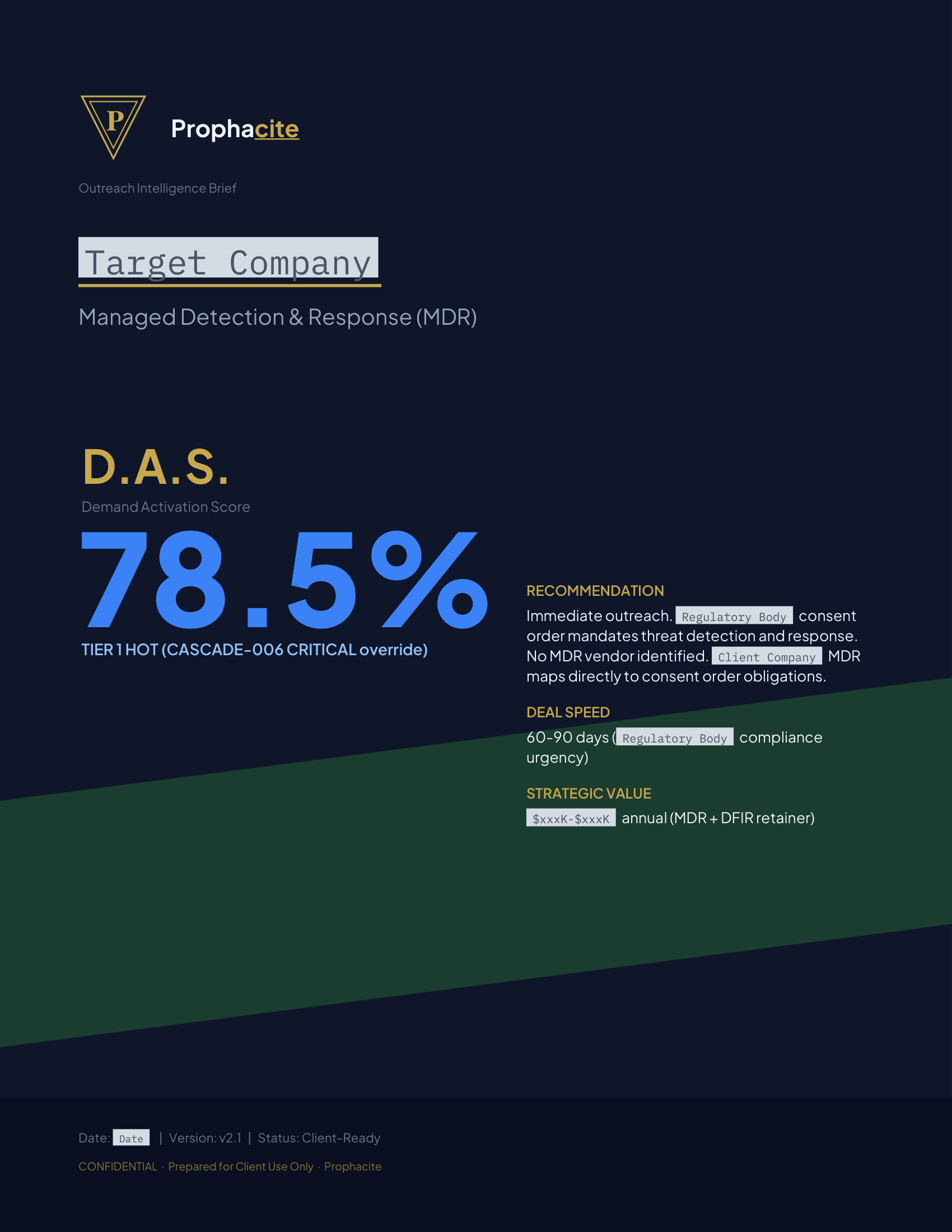
Real deliverables below. Company details have been redacted because we take privacy seriously.
More pages
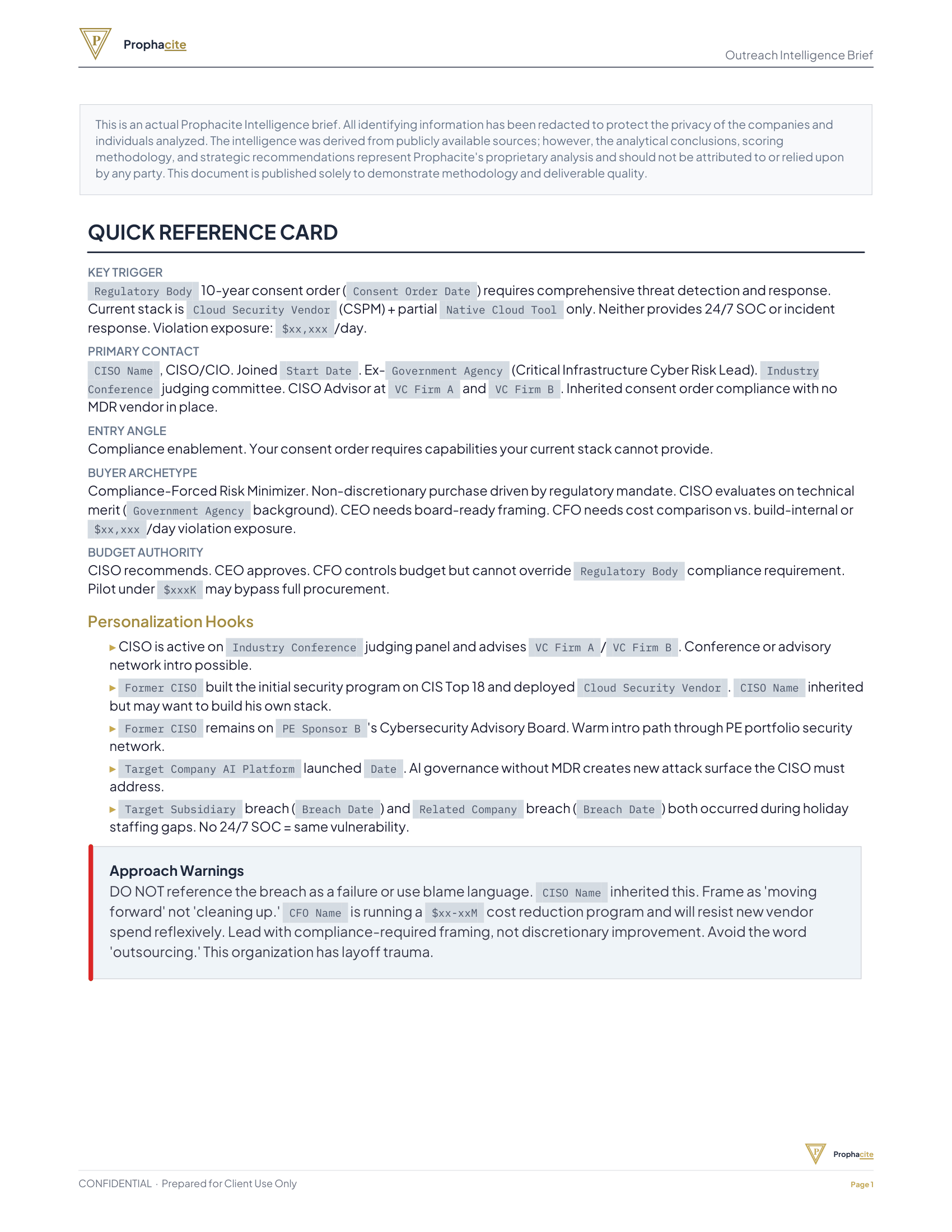
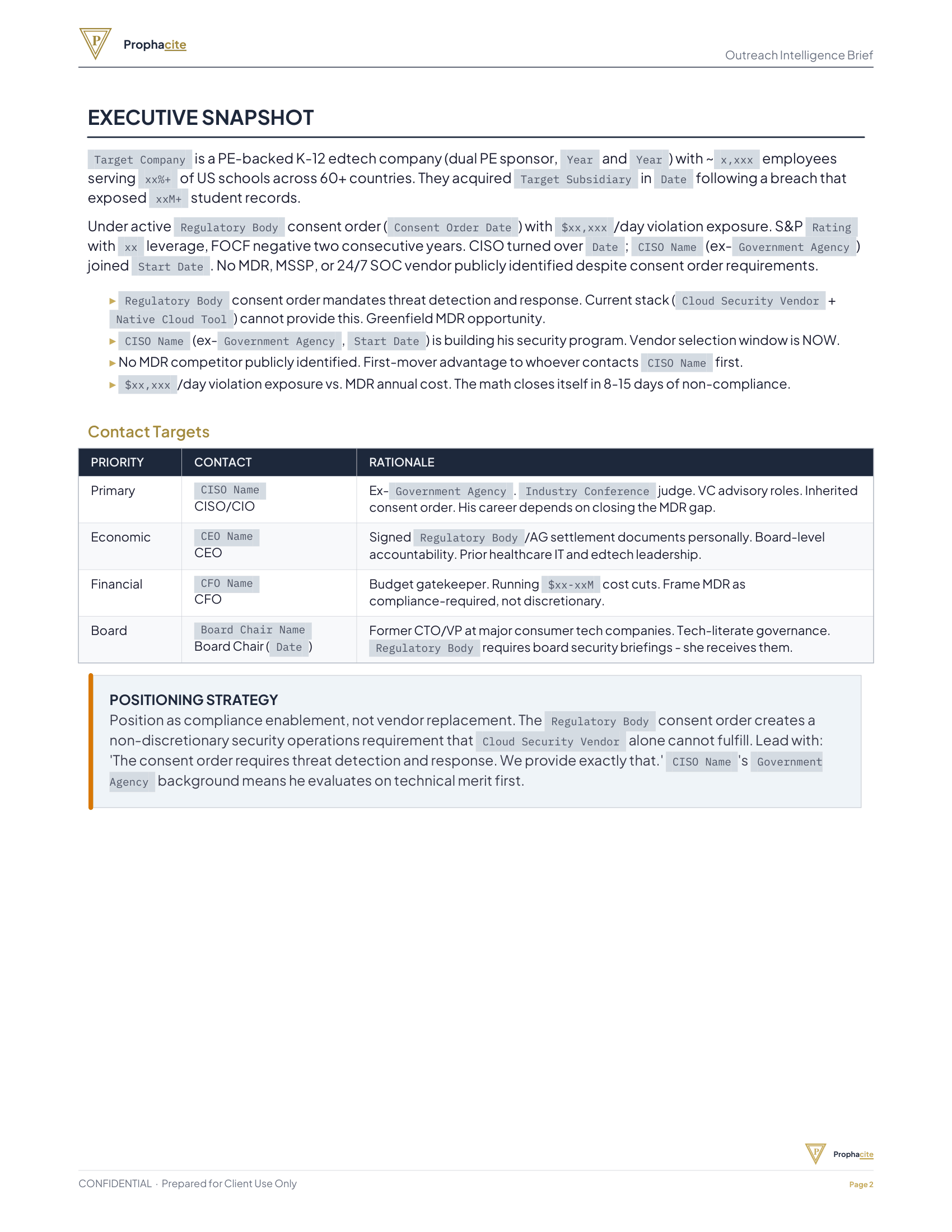
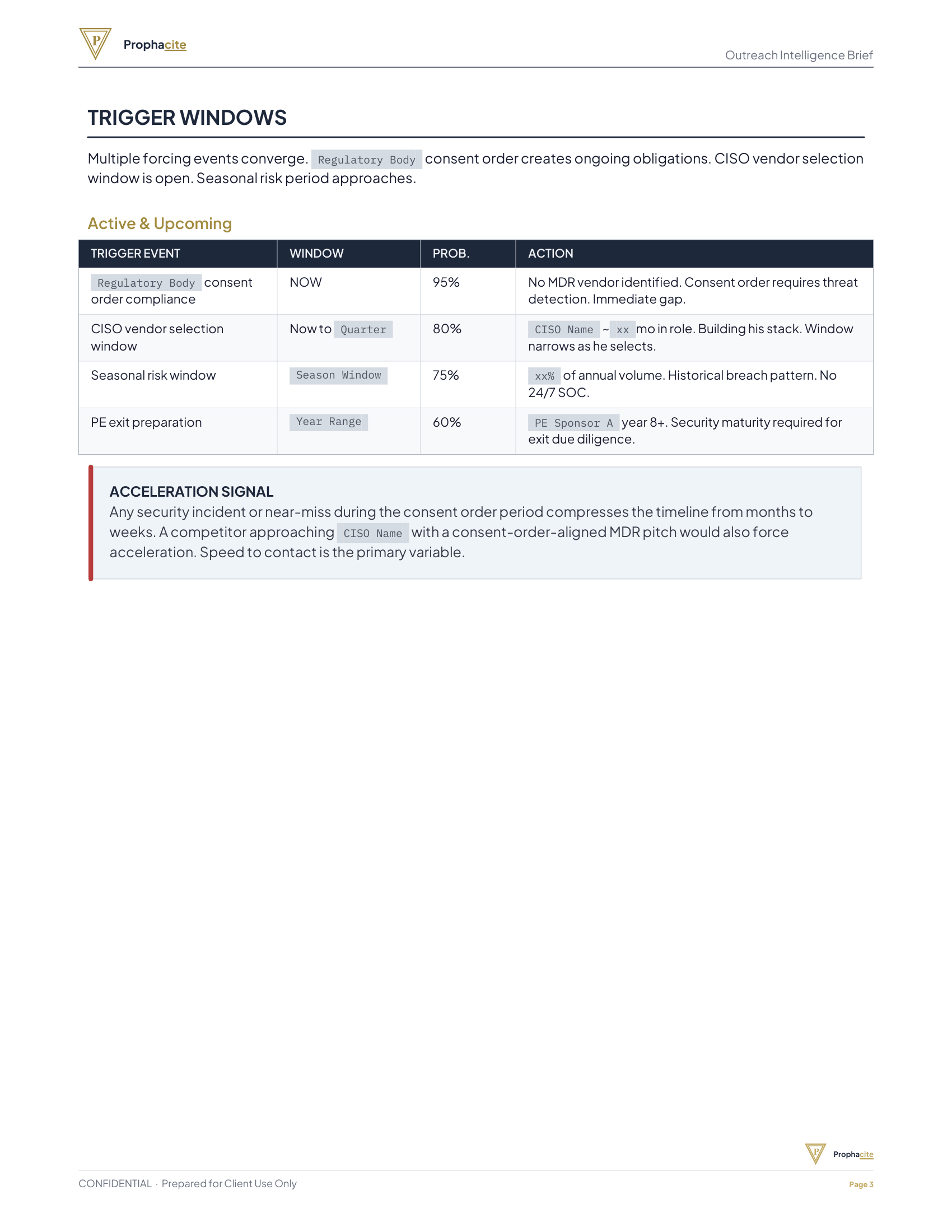
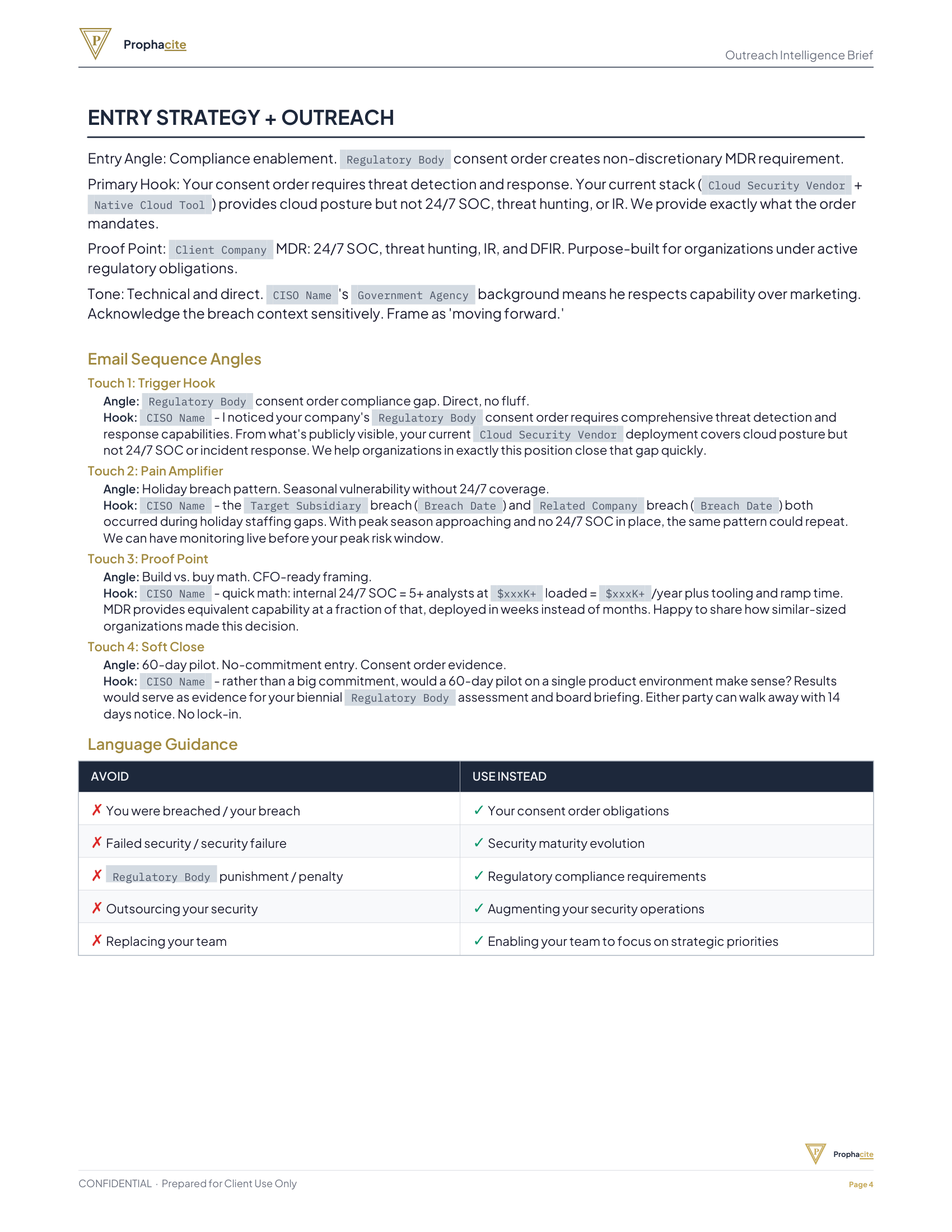
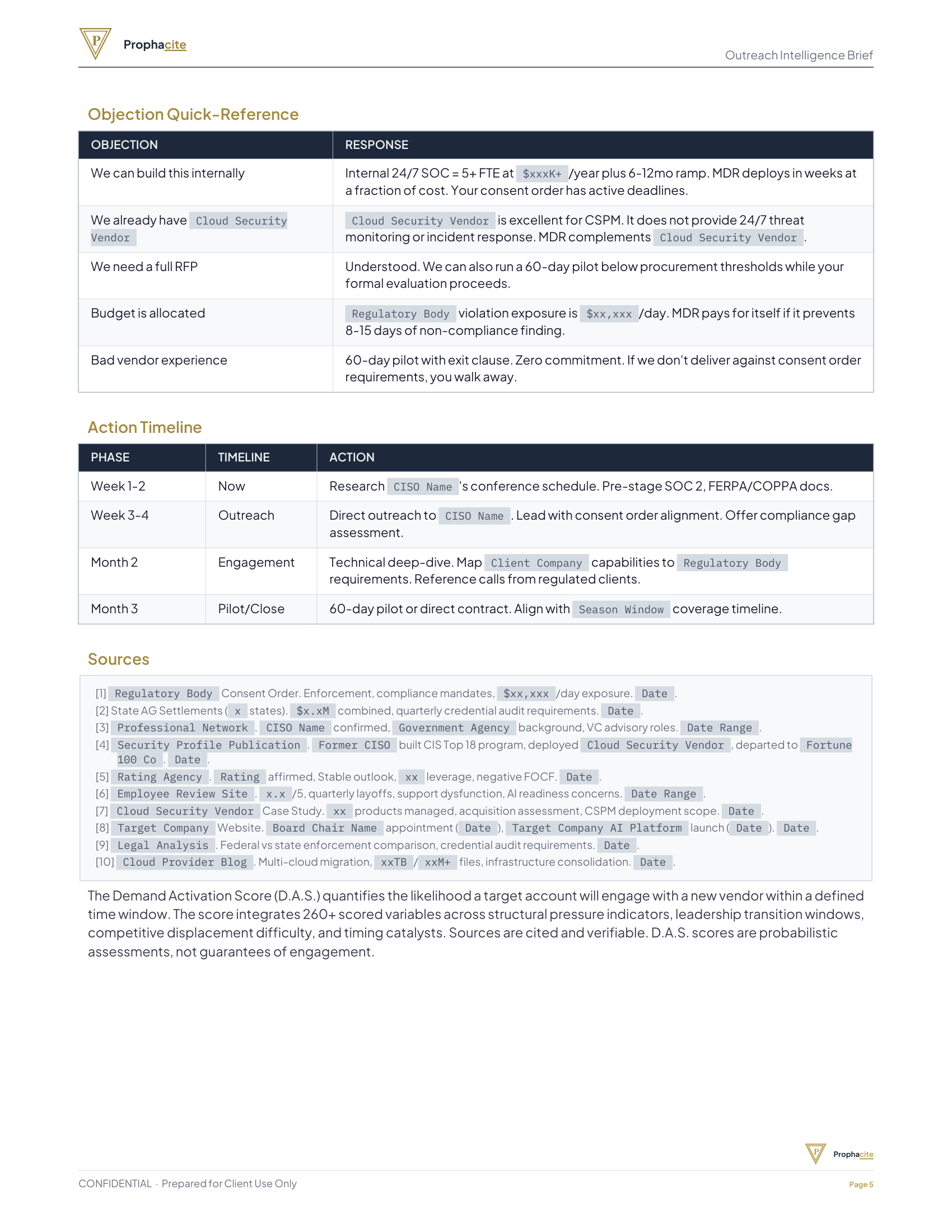
The Outreach Brief above tells your sales team who to call,
when to call, and why they need your call.
The Dossier is 25 pages of everything
the other side of the table doesn't expect you to know.
Most companies in your pipeline
have no structural reason to buy.Most companies in
your pipeline have
no structural reason
to buy.
Not this quarter. Not this year. B2B buying signals alone won't tell you that. We identify converging business conditions before intent data exists.
What is forcing this company to make a decision soon?
We score 31 categories of converging business conditions for account prioritization. Here are five examples.
- Compliance & Regulatory Pressure
A new regulation takes effect next quarter with six-figure penalties for non-compliance. The company has no compliance tooling in place and no vendor selected. That is a buying window with a hard expiration date.
Hard Deadline
- Vendor End-of-Life & Contract Expiry
Their primary platform vendor has announced end-of-support. These sales trigger events create a hard deadline: the contract expires in two quarters and no migration plan has been initiated. Every week of delay compresses the replacement window.
Time-Locked
- Margin Compression & Financial Strain
Gross margins have declined for three consecutive quarters. The board has issued a cost reduction mandate and the CFO is convening a budget committee. Companies under this kind of financial pressure are actively looking for solutions that pay for themselves.
Financial Urgency
- Leadership Change & New Mandate
A new executive has been in the role for less than 90 days and has launched an operational overhaul. Their purchasing history at a prior company confirms familiarity with your product category. The window to engage is open now and narrows as they lock in vendors.
Window Open
- Competitive & Market Displacement
A well-funded competitor has entered their core market segment and is winning share. Their existing position is eroding and a respond-or-concede decision point is approaching within the fiscal year. Companies in this position have budget urgency that didn't exist six months ago.
Threat-Driven
Pre-Intent Intelligence is a purchase readiness analysis built on structural buying pressure analysis rather than behavioral proxies. Where most b2b buying signals originate from keyword tracking and content consumption, this system operates before intent data exists, scoring the financial, operational, and competitive forces that precede any detectable research activity. The methodology addresses core intent data problems by evaluating target company intelligence across 31 categories to find prospects before intent data platforms register a signal.
Because buyer identification b2b has historically depended on firmographic filters and behavioral scoring, account prioritization defaults to companies that match a profile rather than companies under pressure to act. Pre-Intent Intelligence shifts that sequence by integrating purchasing authority analysis and buying committee mapping into the scoring framework, surfacing not just which companies are likely targets but which individuals control the decision.
Pre-Intent Intelligence by Prophacite is a B2B buyer identification product that determines which companies are approaching a purchasing window before they begin researching solutions. Each engagement produces a sourced intelligence brief built for a specific seller's market and deal context.
31 Scoring Categories
Every brief delivers a purchase readiness analysis, scoring your target across these structural dimensions using the D.A.S. scoring framework.
We publish 20 of our 31 scoring categories so you can evaluate the analytical rigor before you buy.
The Deliverables
The same D.A.S. system. Two levels of depth. Both assess b2b purchase readiness. The brief is designed for outreach. The dossier is designed for closing the deal.
What your intelligence contains
- Built for outreach
Pre-Intent Intelligence Brief
6 pages of b2b sales intelligence. Everything your sales team needs to open the conversation and move the deal forward. Buy 5-10 to find your best leads.
Prospecting · First outreach · Better leads · Volume targeting
- Built for closing
Pre-Intent Intelligence Dossier
20+ pages.* Complete target company intelligence the engine produced, structured to dominate every conversation from first meeting through close.
Must-win accounts · Meeting prep · Committee navigation
Includes the outreach brief as a ready-to-use handoff document for your sales team.
| Capability | Pre-Intent Intelligence Brief $1,300 · 6 pages | Pre-Intent Intelligence Dossier $3,000 · 20+ pages* |
|---|---|---|
| Qualify the Target | ||
| D.A.S. analysis and action band | Score + band | Full category breakdown |
| Quick reference card | ✓ Included | ✓ Included |
| Executive snapshot | Summary | Expanded with financials |
| Open the Conversation | ||
| Contact targets | Priority contacts + rationale | Full buying committee mapping + influence analysis |
| Pressure hierarchy | Top drivers listed | Scored with severity ratings |
| B2b buying trigger windows | Active windows + probability | + monitoring calendar |
| Entry strategy | Angle + warnings | Multi-path with psychological angles |
| Buyer archetype & purchasing authority analysis | Archetype + personalization | Full profile, risk scored 0–10 |
| Execute Outreach | ||
| Email sequences | Outreach recommendations | Outreach recommendations |
| Objection handling | Preemptive objections and counter-responses | Expanded with counter-evidence |
| Action timeline | Action timeline | Action timeline |
| Language guidance | Avoid/use table | Avoid/use table |
| Source documentation | Selected sources | Full index with confidence tiers |
| Dominate the Meeting & Close: Dossier Only | ||
| Company financial profile | - | Full metrics, margins, capital structure, investor pressure |
| Full stakeholder map | - | Ambassadors, blockers, wildcards with champion probability |
| Competitive landscape | - | Incumbents, displacement difficulty, exploitable vulnerabilities |
| Financial impact model | - | Cost of inaction, ROI summary with assumptions |
| Contradiction detection | - | Public story vs operational reality |
| Zero-risk pilot framework | - | Pre-built pilot with success criteria and exit clause |
| Deal assessment & risk analysis | - | Deal killers, assumptions, intelligence gaps flagged |
The upgrade path
Start with briefs to find your best leads. When one converts to a meeting, upgrade to the full dossier with a $500 credit toward the dossier price. Buy 10 briefs, close 1 deal, the entire investment pays for itself.
Buy dossier directly
$3,000
Includes the outreach brief
Brief first, then upgrade
$1,300 + $2,500
$500 credit applied to dossier
Save by going direct
Save $800
Dossier direct vs brief-then-upgrade
Every section above is powered by the D.A.S. scoring engine, including 11 protected analytical layers and 4 proprietary amplifiers. What you receive is the conclusion. What produces it runs deeper than any single section can show.
Pricing
Choose Your Intelligence Depth
One-time fee per brief. No subscription. No retainer. No sales call required.
Standard
Most PopularPre-Intent Intelligence Brief
$700 $1,300 Founding Rate
Everything your sales team needs for account prioritization and better leads. 6 pages of actionable intelligence built for outreach.
- D.A.S. analysis with action recommendation
- Contact targets with buyer psychology and approach guidance
- Entry strategy with personalization hooks and warnings
- Email sequences and objection handling
- Buying trigger windows with probability scoring
- Phased action timeline
- $500 credit when upgrading from a brief
Delivery: 2-5 business days
Elite
Pre-Intent Intelligence Dossier
$1,500 $3,000 Founding Rate
Everything in your Pre-Intent Intelligence Brief, with every section expanded to 3x the analytical depth. Plus 7 exclusive deep-analysis sections found nowhere else.
- 7 additional deep-analysis sections: competitive, financial, regulatory, contradiction detection, and more
- Triple-pass verification with expanded source depth
- Decision-maker profiles with full psychology mapping
- Financial impact modeling with ROI projections
- Complete source index with confidence scoring
- Download a full sample dossier to see the depth
- 20+ pages of deep analysis*
- Includes the outreach brief at no additional cost
Delivery: 4-8 business days
Founding rates are available for our first 100 intelligence products. When slots fill, prices move to standard.
Brief
$700 $1,300 Save $600
Dossier
$1,500 $3,000 Save $1,500
*Over 70% of dossiers exceed 20 pages. Page count varies by target. Some targets with limited available intelligence produce shorter deliverables because we do not pad with filler. Every page earns its place.
Every report is engineered around your specific company, your specific target, and your specific deal context.
That is not an add-on. That is the Prophacite standard.
From intake to intelligence before intent data fires
01
Tell Us What You Sell
You describe your product or service, ideal customer profile, and what a good lead looks like.
02
We Calibrate Your Pressure Model
We tailor the scoring framework specifically to your product and market. No templates. No one-size-fits-all.
03
We Run the Analysis
350+ vectors scored across 31 categories per target. Sales trigger events verified from multiple sources, contradiction-checked, and confidence-scored.
04
Actionable Lead Intelligence Delivered
A complete brief to find prospects before intent data platforms register a signal, with scored pressure drivers, decision-maker profiles, approach strategy, and timing windows. Standard delivery:
2-5 business days.
The distinction between b2b buying triggers detected through publisher networks and those identified through structural analysis determines whether a sales team arrives early or competes on a level field. Sales trigger signals such as vendor contract expirations, compliance deadlines, and leadership mandates are sales trigger events that exist in public data before any buying trigger windows open in conventional platforms. The D.A.S. system scores b2b purchase readiness by measuring how these business conditions creating demand converge within a single organization, weighting severity, timeline, and budget availability across 350+ vectors. Rather than tracking organizational buying dynamics after a company enters the market, the framework isolates the upstream forces that will push them there, producing outbound sales intelligence calibrated to each engagement.
For teams whose b2b sales intelligence stack relies on behavioral scoring alone, the distinction operates at the workflow level. Buyer intent analysis tools and lead scoring external data systems measure what has already happened; revenue intelligence for sales teams built on converging business conditions measures what is about to. BDR prospect research that relies on the same external business signals available to every competitor produces commodity targeting. Pre-Intent Intelligence operates on a structural signal layer that shared platforms do not currently score, because the analysis is configured per engagement rather than aggregated across a publisher network.
The structural alternative to intent data
Not a replacement for your CRM or database. Outbound sales intelligence from a different category entirely.
How Pre-Intent Intelligence compares to intent data providers, sales databases, and consulting firms for finding better leads.
| Capability | Data Platforms | Intent Tools | Internal Research | Consulting Firms | Prophacite |
|---|---|---|---|---|---|
| Why a company needs to buy | Not tracked | Keyword signals only | Manual, inconsistent | Deep but slow (months) | Scored across 31 categories in days |
| When the buying trigger window opens | Not tracked | Not tracked | Anecdotal | Estimated, no scoring | Buying trigger windows scored with probability |
| How to get in the door | Contact data only | Contact data only | LinkedIn research | Strategic advice | Entry strategy + objection handling |
| Contradiction detection | Not available | Not available | Not systematic | Manual, expensive | Public statements cross-referenced against operational data |
| Time to actionable revenue intelligence for sales teams | Instant (raw data) | Instant (signals) | 1-3 weeks | 4-12 weeks | 2-5 business days, structured for immediate use |
Common questions
What teams ask before ordering their first brief.
-
Regulatory deadlines, vendor expirations, margin compression, leadership changes, and budget cycles are all sales trigger signals in public information. The difference is knowing how these business conditions creating demand affect each other. When a compliance deadline converges with a new executive mandate and a vendor contract expiration in the same quarter, the pressure to act compounds. The D.A.S. framework is built to score that convergence across 31 categories and surface the companies where multiple structural forces are building simultaneously.
-
We find companies under converging business conditions to buy your product, then deliver a 6-page actionable playbook on each one. The brief replaces hours of bdr prospect research with a scored pressure analysis using the D.A.S. across 31 categories, decision-maker profiles with approach guidance, entry strategy, timing windows, and verified source documentation. Each brief is custom-built for your product and market and delivered in 2-5 business days. The value is not just the analysis. It is finding leads your team would not have known to pursue. For deeper analysis, the Pre-Intent Intelligence Dossier expands every section to 3x analytical depth and adds 7 exclusive deep-analysis sections.
-
Intent data tells you someone at a company searched for a keyword. Lead scoring external data ranks contacts by demographics and behavioral signals. These are core intent data problems: both track what has already happened, and neither answers why a company needs to buy, when the window opens, or how to approach. Pre-Intent Intelligence analyzes converging business conditions: the operational and financial forces that create demand before the buying process begins. The deliverable includes scored pressure drivers, decision-maker profiles, and approach strategy built from verified, multi-source analysis. See how we compare.
-
For some teams, yes. If your sales motion is built around targeted, high-value engagements and you have the capacity to work fewer accounts at greater depth, Pre-Intent Intelligence can be your primary pipeline source. But for most organizations, the stronger play is using both. Pre-Intent Intelligence tells you where to point your best people. It identifies the leads worth investing real effort in, the ones where converging business conditions are building and the timing is right. Intent data keeps your volume outreach running so you do not miss deals from companies that move without many structural indicators. Most sales teams already operate this way: a targeted team focused on high-value relationship selling, and a volume team focused on broad outreach. Pre-Intent Intelligence is built for the first. Intent data serves the second. Running both means your best reps are working the highest-value opportunities while your pipeline never goes quiet.
-
Intent data platforms monitor keyword searches and content consumption across publisher networks. That is useful once a buyer is actively researching. What it cannot capture is the structural forces that cause the research to begin in the first place: regulatory deadlines, vendor contract expirations, margin compression, leadership changes, and budget cycles. These are b2b buying signals that exist before any search activity. Pre-Intent Intelligence scores those upstream pressures across 31 categories to identify companies approaching a buying decision before they take any action that intent platforms can detect.
-
Everything we analyze is built from public data intelligence and open-source information. But this is not the first ten pages of a Google search. Our research pulls from hundreds of sources across categories that most teams do not know exist or do not have the process to monitor. The value is not in any single source. It is in how the D.A.S. framework cross-references findings across source types to surface patterns and contradictions that no individual source would reveal on its own.
-
Pre-Intent Intelligence Briefs are delivered in 2-5 business days. Dossiers are delivered in 4-8 business days. Rush delivery is available for time-sensitive engagements. Every deliverable is analyst-reviewed before release. See the full process.
-
We do not deliver leads we would not stake our name on. If we cannot build a brief worth acting on, we refund proactively. If a signal is useful but not fully verified, we separate it from confirmed findings and label the confidence level clearly. If your intake needs more detail, we reach out before starting. The standard is simple: every deliverable must be worth more than what you paid for it, or we do not release it. See our guarantee.
-
A shorter dossier typically means the target company had less publicly available intelligence, which means we spent more time sourcing, verifying, and cross-referencing to produce what is there. The research effort on a 16-page dossier often exceeds a 28-page one because every finding had to be extracted from harder-to-reach sources. We do not pad deliverables with filler to hit a page count. You are paying for the depth of the research and the quality of the analysis, not the number of pages. We do not deliver a product that does not demonstrate its value. That is our guarantee.
-
Converging urgency indicators are operational, financial, regulatory, and competitive forces that create demand independent of a company's stated intentions. When a vendor contract expires, a compliance deadline approaches, margins compress, or a new executive inherits legacy infrastructure, the organizational buying dynamics shift regardless of whether they have started searching. These are business conditions creating demand independent of stated intentions. The D.A.S. framework scores these converging pressures across 31 categories to surface companies where multiple forces are building simultaneously.
-
The Demand Activation Score quantifies the converging business conditions identified during research as a purchase readiness analysis. It scores 31 categories using 350+ vectors to produce a composite pressure score, confidence level, and timing assessment. Higher scores indicate converging structural forces that typically precede purchasing decisions. Each engagement is calibrated to your product and ideal customer profile. Learn how the D.A.S. works.
-
Yes. Requesting a brief on a specific company is handled as an enterprise engagement. Reach out directly to support@prophacite.com to start the process.
-
Most sales intelligence tools wait for b2b buying signals that only appear once a company is already in-market: keyword searches, content downloads, pricing page visits. By then, every competitor with the same intent data subscription sees the same signal. Pre-Intent Intelligence works upstream for buyer identification b2b. It identifies the structural forces that will cause a company to start searching, before they take any action that conventional tools can detect. The result is a scored account intelligence brief with decision-maker profiles and approach strategy, helping you find prospects before intent data platforms register the opportunity.
-
Isolated sales trigger signals like job changes or funding announcements are easy to find but difficult to act on alone. What separates a company that might buy someday from one approaching a buying trigger window is convergence: multiple b2b buying triggers compounding in the same window. The D.A.S. framework is built to score that convergence. See how the scoring system works.
-
The D.A.S. framework is designed to be universal. We have not encountered an industry where the system cannot be applied. External business signals like regulatory deadlines, competitive shifts, leadership changes, and financial constraints operate across all sectors. The scoring model calibrates dynamically to your product, market, and ideal customer profile.
-
Intent platforms track anonymous account-level activity. They surface that someone at a company searched a keyword, but they cannot distinguish whether it was the CEO or an intern browsing during lunch. They do not tell you who searched, what role they hold, whether they have budget authority, or what internal pressure is driving the search. Pre-Intent Intelligence maps the buying committee: who controls the budget, who champions internally, who blocks, and what each person is managing inside the organization. The brief delivers named contacts with approach strategy, not anonymous signals.
-
When intent-flagged accounts do not convert, the data is rarely the only factor. Conversion depends on timing, messaging, internal priorities, budget cycles, and whether the company has a structural reason to act. Intent signals measure research activity, which is one input among many. A company downloading a whitepaper may be a junior analyst building a report, not a decision-maker evaluating vendors. Pre-Intent Intelligence evaluates whether the structural conditions for a purchase exist: budget availability, leadership mandate, operational pressure, and timing convergence. It does not replace any single factor in your sales process, but it does answer a question intent data cannot: is there a structural reason this company needs to buy?
-
Intent data fires when a company starts researching. By that point, every vendor with the same subscription sees the same signal within the same window. The timing advantage is measured in hours, not weeks. Pre-Intent Intelligence operates upstream, identifying the structural forces that will cause the research to begin. The brief arrives before any intent platform registers activity.
-
Because they subscribe to the same platforms. Bombora, 6sense, Demandbase, and ZoomInfo all monitor overlapping publisher networks. When a company triggers an intent signal, every subscriber sees it simultaneously. Pre-Intent Intelligence uses an entirely different signal layer: converging business conditions detected through financial, operational, regulatory, and competitive analysis. These signals are not available on any shared platform.
-
Most ABM lists are built from firmographic and technographic filters: industry, company size, tech stack. These describe what a company looks like, not what it is experiencing. A company can match your ICP perfectly and have zero urgency to buy. Pre-Intent Intelligence prioritizes accounts based on converging business conditions, identifying which companies in your market are under conditions that create demand for what you sell, regardless of whether they match a static profile.
-
Predictive platforms assign intent scores based on behavioral patterns across publisher networks. A score reflects research activity, not buying intent. Companies research categories for many reasons: benchmarking, internal reporting, competitive analysis, analyst requests. The score cannot distinguish between genuine evaluation and ambient curiosity. Pre-Intent Intelligence does not score behavior. It scores structural conditions that compel action.
-
Because intent alerts arrive without context. A notification that a company is "showing intent" does not answer the five questions your reps need before they pick up the phone: who to call, what pressure they are facing, when the window opens, why this company needs your product or service, and how to approach each decision-maker. Pre-Intent Intelligence delivers a complete brief that answers all five: the specific pressure driving urgency, the decision-makers who control the outcome, an entry strategy calibrated to each person, and a timing window showing when conditions peak. That is what makes your team pay attention.
-
By scoring structural pressure instead of behavioral signals. Not every company in your pipeline faces the same urgency to act. Pre-Intent Intelligence evaluates which targets are under converging financial, operational, and competitive forces that create a purchase timeline. The D.A.S. score ranks targets by the strength and urgency of those forces, giving your team a prioritization framework that does not depend on whether anyone at the company has searched a keyword.
-
Either they identified the opportunity before intent signals fired, or they received the same signal and moved faster. In most cases, the competitor who wins is the one who arrived before the buyer started evaluating options. Pre-Intent Intelligence is designed to surface opportunities during the window between structural pressure building and intent signals appearing. First contact in that window sets the terms of the conversation.
Explore Other Products